
Farm fires shifting to evenings are evading satellite detection, study finds
Commission for Air Quality Management works with ISRO and Punjab to improve stubble burning estimation beyond satellite fire counts.

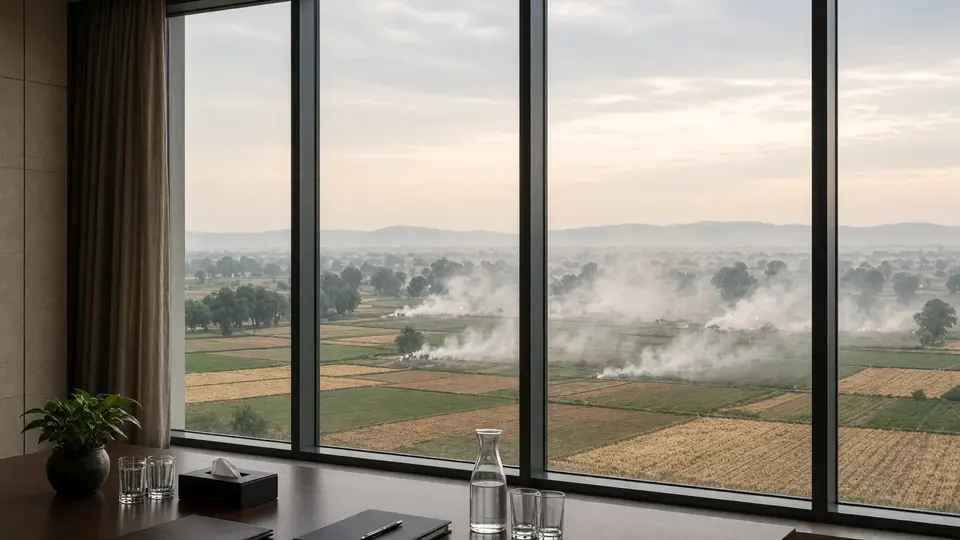
The Commission for Air Quality Management has begun working with the Indian Space Research Organisation and state governments to develop more accurate methods for measuring farm fires ahead of the winter pollution season, moving beyond satellite-based fire counts that have proven unreliable.
Rajesh Varma, Chairman of CAQM, told reporters that the body is seeking "better 'ground truthing' protocols" in discussions with ISRO and Punjab authorities, acknowledging that "fire counts reported from satellite passes may not be the most accurate picture of the extent of farm fires".
Timing shift masks extent of burning
The push for improved measurement comes after mounting evidence since 2024 showed Punjab's claims of a 90% reduction in farm fires since 2021 were exaggerated. An ISRO Space Applications Centre study found farmers shifted burning to evenings to evade daytime satellite detection, with peak fire activity moving from 1.30 p.m. in 2020 to around 5 p.m. in 2024. The adjustment allowed farmers to avoid fines while continuing the practice.
Alternative satellite data analysing 'burnt area', actual land affected by fire, revealed a more modest 30% decline, from approximately 31,500 sq km in 2022 to 19,700 sq km in 2025, according to research outfit iForest.
Protocol challenges
Varma described protocol development as "complicated," noting that while burnt area offers better acreage estimates, it does not accurately measure particulate matter emissions. "The pollution level depends on straw quantity, moisture, combustion efficiency and per-pollutant emission factors which satellites can't measure," he explained, adding that sensor resolution also affects accuracy.
Despite the limitations, CAQM has asked ISRO to provide a basic protocol this year "so that we can make a beginning in getting a better estimate than fire counts".
Winter pollution impact
Farm fires contribute no more than 15% of winter particulate matter pollution overall, but during certain weeks in October and November their share can spike to 44%, several studies have shown. The burning peaks when monsoon withdrawal stalls westerly winds that normally disperse pollution from vehicles, industry, road dust and agricultural waste. Farmers burn paddy stubble after harvesting as the most economical and quickest method to prepare fields for wheat sowing.
Source: The Hindu
Frequently asked questions
Why are satellite-based farm fire counts unreliable?
Farmers have shifted burning to evenings to evade daytime satellite detection. Peak fire activity moved from 1:30 p.m. in 2020 to around 5 p.m. in 2024, allowing farmers to avoid fines while continuing the practice. Additionally, satellites cannot measure particulate matter emissions accurately, as pollution levels depend on straw quantity, moisture, combustion efficiency, and emission factors.
What does the data show about farm fire reduction in Punjab?
Punjab's claims of 90% fire reduction since 2021 were exaggerated. Alternative satellite data analyzing burnt area, actual land affected by fire, revealed a more modest 30% decline, from approximately 31,500 sq km in 2022 to 19,700 sq km in 2025.
How much do farm fires contribute to winter pollution?
Farm fires contribute no more than 15% of winter particulate matter pollution overall, but during certain weeks in October and November their share can spike to 44%. This occurs when monsoon withdrawal stalls westerly winds that normally disperse pollution from vehicles, industry, and other sources.
What is CAQM doing to improve farm fire measurement?
The Commission for Air Quality Management is working with the Indian Space Research Organisation and state governments to develop more accurate measurement methods, including better 'ground truthing' protocols. ISRO has been asked to provide a basic protocol this year to get better estimates than traditional fire counts.
You may also like
 Politics
AAP's drug war promises delayed six times, Delhi CM alleges ahead of BJP yatra
 Politics
Power cuts cripple Punjab's rice mills during critical Basmati season
 Crime
Crime
Punjab Police extradites fugitive gangster Amrit Dalam from Moldova after six-month manhunt
 National
Illegal school in Chandausi shut down after safety violations found during inspection
Most read
- 1
Tesla audits Chinese suppliers to scale up Optimus robot production
- 2
Former minister Lakhan Singh Rajput to inaugurate temple bhandara at Shri Chakreshwar Mahadev
- 3
Firozabad BSA finds four government schools locked during inspection
- 4
Tamil Nadu dengue cases fall for third consecutive year to 17,049
- 5
Social workers stage silent protest at Fufund railway station for train halts
Comments
No comments yet. Be the first to comment.