
Dhruv Rathee detained by Delhi, Gurugram police ahead of Jantar Mantar protest
Delhi and Gurugram police detained YouTuber Dhruv Rathee in Gurugram before a youth-led protest against Election Commissioner Gyanesh Kumar.

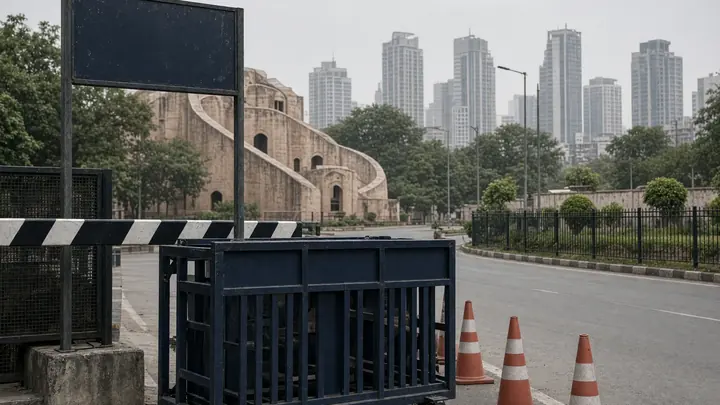
A joint operation by Delhi and Gurugram police detained YouTuber Dhruv Rathee from a residential flat in Gurugram on Saturday morning, ahead of a planned protest at Jantar Mantar against Chief Election Commissioner Gyanesh Kumar.
Detention ahead of Jantar Mantar protest
The detention took place on October 10, 2026, as authorities prepared for a youth-led demonstration in central Delhi demanding the resignation of Kumar.
Sources in intelligence agencies said the operation involved the Delhi and Gurugram police.
Rathee was staying with his parents at a flat in Central Park Vihar, Sector 56, Gurugram, when police personnel reached the residence.
He was reportedly taken to an undisclosed location in Gurugram.
The planned protest was called by the Cockroach Janta Party, or CJP, a youth-based political movement that has led a wave of demonstrations over changes to voter lists.
Saturday’s rally was expected to be the biggest yet in a series of near-daily protests, according to Al Jazeera.
Organisers had presented the demonstration as a protest to “Save Democracy”.
The CJP wants Chief Election Commissioner Gyanesh Kumar to quit over a revision of voter lists that protesters and critics have challenged.
The dispute over the voter lists has become the central issue behind the demonstrations and the security measures imposed in Delhi.
Heavy restrictions in central Delhi
India deployed thousands of police and paramilitary personnel in central Delhi ahead of the protest.
Police and authorities also restricted transport in and around the capital as the demonstration approached.
Police did not authorise the rally at Jantar Mantar, a site that authorities usually designate for protests.
Authorities said the request for permission had not been made on time and that the CJP had violated undertakings given during earlier protests.
Police warned that protesters would face a forceful law enforcement response if they violated the ban.
Roads leading to the protest site were blocked with multiple layers of metal barricades.
Authorities also shut 57 metro stations from Friday night.
Several long-distance trains were cancelled, while mobile internet was suspended within 4km (2.5 miles) of the protest area until Saturday night, the Indian news agency ANI reported.
India’s Supreme Court said on Friday that some trains must still run and that a blanket closure of metro stations was unlikely.
These restrictions placed the detention of Rathee within a wider official response to the planned mobilisation, which authorities had not permitted at the designated protest site.
The CJP said at least 10,000 people, including protesters travelling to Delhi by train, had been detained across the country.
That figure was the organisation’s claim and was not presented in the source as an independently confirmed total.
CJP chief Abhijeet Dipke criticised the restrictions in a post on X, saying: “The dictator would rather shut down the entire national capital and inconvenience millions of citizens than allow a peaceful protest at a designated protest site.”
Neha Bora, national president of the All India Students’ Association and a leading face of the protests, said: “You can detain the people, you cannot detain the movement.”
Why the protesters are demanding the election chief’s resignation
The protesters are opposing a revision of voter lists that has removed more than 130 million names, according to the report.
The Election Commission says the exercise removes duplicate and ineligible voters.
It also says the revision aims to prevent “foreign illegal immigrants” from voting.
Critics, however, say the exercise has disproportionately affected marginalised and minority communities.
The protests intensified after The Indian Express reported that Kumar’s two deputies had formally raised concerns at least 14 times in the past 10 months over the revisions.
The Election Commission and the Bharatiya Janata Party have denied the allegations.
The BJP has said the opposition is misleading the country because it cannot win elections.
The issue has therefore brought together concerns over voter-list changes, demands for accountability from the Election Commission and a broader campaign against the BJP-led political establishment.
The CJP began online as political satire in May, after Chief Justice Surya Kant called unemployed youth “cockroaches”, an episode that sparked nationwide outrage.
Since then, the CJP has built a large following among India’s youth.
The movement’s July protests led to the resignation of Modi’s education minister over exam paper leaks.
The latest demonstrations are taking place months before a series of state elections scheduled for early 2027.
Those elections include Uttar Pradesh, India’s most populous state, which is governed by the BJP.
BJP accuses opposition of seeking instability
The BJP has accused opposition groups of trying to destabilise India at the behest of foreign forces as protests continued.
BJP president Nitin Nabin, speaking at a press conference in Delhi, described the opposition as “anarchic”.
He accused opposition parties of refusing to accept the people’s verdict and pursuing political agendas to create instability.
Nabin alleged that associates of Congress party leader Rahul Gandhi and Aam Aadmi Party leader Arvind Kejriwal were leading Saturday’s protests.
He did not name the CJP, which was the main organisation that called for the demonstrations.
The CJP is not a registered political party, but a collective that now works as a pressure group.
Nabin said India was making progress despite global crises.
He also said the opposition could not “digest India’s growth, progress, and advancement”.
Opposition parties, mainly the Congress, have been out on the streets this week demanding the election chief’s resignation.
Nabin warned that the opposition’s efforts would fail.
“Indian democracy possesses immense strength, and the patriots of this nation will unite to thwart your designs,” he said.
The detention of Rathee came as the government and the opposition presented sharply different accounts of the protest movement.
The BJP described the demonstrations as an attempt to create instability, while the CJP and other protest leaders framed them as a campaign to defend democracy and challenge the voter-list revision.
Police restrictions, transport disruptions and detentions accompanied the dispute over whether the protest could proceed at Jantar Mantar.
The planned demonstration was also part of a movement that has grown from online political satire into a youth-led pressure campaign with national political consequences.
Frequently asked questions
Who detained Dhruv Rathee?
Delhi and Gurugram police detained YouTuber Dhruv Rathee.
Where was Dhruv Rathee detained?
He was detained from a residential flat in Central Park Vihar, Sector 56, Gurugram.
When was Dhruv Rathee detained?
He was detained on October 10, 2026, ahead of a planned protest at Jantar Mantar.
Why was the protest planned?
The Cockroach Janta Party called the protest to demand Chief Election Commissioner Gyanesh Kumar’s resignation over revisions to voter lists.
You may also like
 Politics
Delhi Police Detain Cockroach Janata Party Founder Before Proposed Connaught Place March
 Uttar Pradesh
Colors for Peace Brings 1,500 Students Together in New Delhi
 Weather
Delhi-NCR May See Six Days Of Rain As Yellow Alert Issued
 Politics
CJP Protest Delhi: Abhijeet Dipke, 2 Others Released on One-Year Peace Bond
Most read
- 1
Air China Adds Extra Flight for Passengers Stranded in Fuel-Starved Cuba
- 2
Western disturbance to bring rain, hail and strong winds across north India
- 3
Yogi Adityanath Directs No Occupied Houses Be Demolished for Achhalda Bridge
- 4
Gwalior Temple Truck Crash Kills 12, Injures 28-29 Devotees During Navratri
- 5
Schools Shut in Five Tamil Nadu Districts, Including Chennai, Amid Heavy Rain
Comments
No comments yet. Be the first to comment.