
Ancient 2,000-year-old burial chamber discovered in Kerala's Kasaragod district
Laterite burial chamber from megalithic period discovered at Kanhangad in Kasaragod, revealing ancient human settlement and funeral practices.

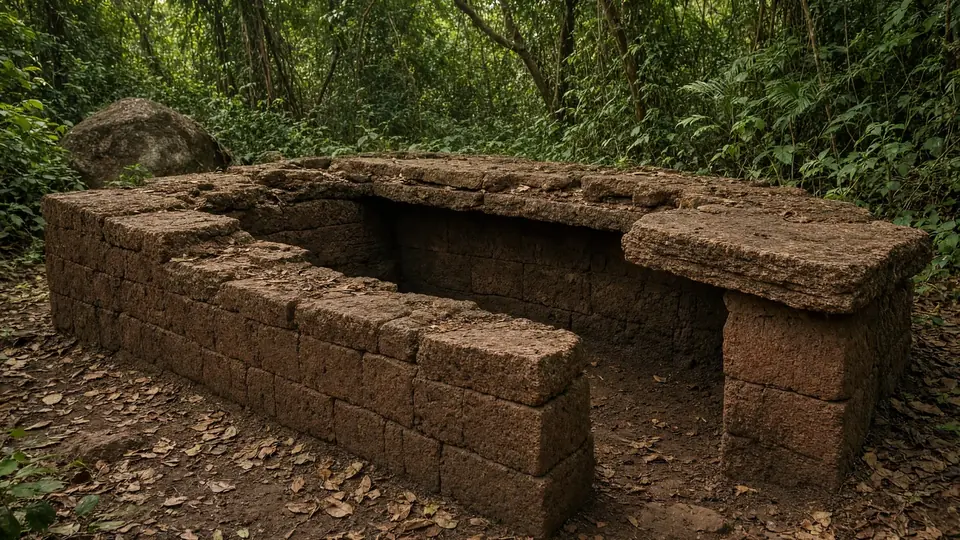
A laterite burial chamber dating back approximately 2,000 years to the Megalithic period has been unearthed at Nittadukkam in Kanhangad municipality, Kasaragod, confirming human habitation in the area during ancient times.
The burial chamber was discovered on land owned by N. Sajith Kumar, an information technology employee living at Chithira in Nittadukkam. The structure is believed to have been built as part of funeral practices during the Megalithic period.
Expert verification
Nandakumar Koroth, history researcher and head of the Department of History at Nehru Arts and Science College, Kanhangad, inspected the site and identified the structure as a laterite burial chamber or rock-cut megalithic burial. Officials from the Kerala State Department of Archaeology also confirmed it could be a megalithic chamber.
The chamber has been carved into laterite rock with a circular interior, and its entrance is currently sealed with stones. A section that would typically contain steps leading to the chamber is now covered with soil. At the centre of the upper section sits a circular opening measuring about 50 cm in diameter. The original stone slab that once covered this opening now lies on the ground. According to the property owners, a large rock was placed over the opening roughly 75 years ago to replace the slab.
Potential burial contents
The chamber is presently filled with soil, making it impossible to determine whether pottery or other burial objects remain inside. Megalithic burial chambers were generally constructed for funeral purposes, with ash, bones and other objects, along with pottery and iron weapons, typically placed inside as part of burial rituals. Such monuments were constructed before the 3rd century AD, according to historical accounts.
Locally, these structures are known by names such as Muniyara, Pandava Guha, Paranki Guha, Muthalpetti, Nidhikuzhi and Kaippathayam. Mr. Koroth said the monument at Nittadukkam has survived largely because of local beliefs surrounding it and is now considered one of the oldest surviving indicators of Kanhangad's human past.
The discovery strengthens Kanhangad's archaeological profile, which already includes Hosdurg Fort built in 1731, remnants associated with military expeditions of the 17th and 18th centuries, traditional nalukettu houses and places of worship. Kasaragod district has yielded several types of Megalithic monuments, including rock-cut burial chambers, dolmens, umbrella stones, capstones, urn burials, stone circles and rock paintings, highlighting the region's rich prehistoric and early historic archaeological heritage.
Source: The Hindu
Frequently asked questions
How old is the burial chamber discovered in Kasaragod?
The laterite burial chamber dates back approximately 2,000 years to the Megalithic period. It was discovered at Nittadukkam in Kanhangad municipality, Kasaragod district.
What is inside the burial chamber?
The chamber is currently filled with soil, making it impossible to determine what remains inside. Megalithic burial chambers typically contained ash, bones, pottery, iron weapons, and other burial objects as part of funeral rituals.
What is the structure of the burial chamber?
The chamber is carved into laterite rock with a circular interior. It features a circular opening measuring about 50 cm in diameter at the centre of the upper section, and its entrance is currently sealed with stones.
Who verified the discovery?
Nandakumar Koroth, a history researcher and head of the Department of History at Nehru Arts and Science College, Kanhangad, inspected the site and identified it as a megalithic burial chamber. Officials from the Kerala State Department of Archaeology also confirmed it could be a megalithic chamber.
What other archaeological sites are in Kasaragod?
Kasaragod has yielded several types of Megalithic monuments, including dolmens, umbrella stones, capstones, urn burials, stone circles, and rock paintings. The district also has Hosdurg Fort built in 1731 and remnants from 17th and 18th century military expeditions.
You may also like

Most read
- 1
Tesla audits Chinese suppliers to scale up Optimus robot production
- 2
Former minister Lakhan Singh Rajput to inaugurate temple bhandara at Shri Chakreshwar Mahadev
- 3
Firozabad BSA finds four government schools locked during inspection
- 4
Tamil Nadu dengue cases fall for third consecutive year to 17,049
- 5
Social workers stage silent protest at Fufund railway station for train halts
Comments
No comments yet. Be the first to comment.