
Parentspathy Book Presents A New Approach To Balanced Parenting
Parentspathy: Moving Beyond Traditional Parenting Towards a Healthy and Balanced Lifestyle Can a child’s better future be secured only through good education, reputed schools and improved facilities?

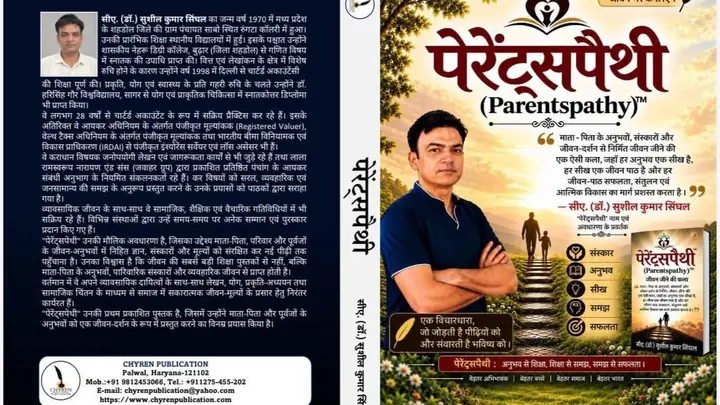
Parentspathy: Moving Beyond Traditional Parenting Towards a Healthy and Balanced Lifestyle
Can a child’s better future be secured only through good education, reputed schools and improved facilities? Or does it also depend on a well-organised routine, healthy habits, mental balance and family values?
These questions are becoming increasingly relevant as children’s lives grow busier, more irregular and more dependent on technology. Late nights, late mornings, limited physical activity, increasing time spent on mobile phones and screens, and irregular eating habits are becoming part of everyday life.
Against this backdrop, CA. Dr. Sushil Kumar Singhal’s book ‘Parentspathy’ presents a different way of looking at parenting and family life. The book goes beyond traditional advice on raising children and focuses on the idea that a well-managed daily routine can help move life towards greater balance and healthier habits.
A different way to look at parenting
Discussions about children’s development and upbringing generally focus on education, career, behaviour, discipline and future plans. Parents often pay close attention to the school a child attends, the marks the child obtains and the profession the child may choose later in life.
‘Parentspathy’, however, takes the reader back to a basic question: have children been taught the habits required to live a better life?
The book’s central perspective is that the quality of life is shaped not only by achievements, but also by the small habits followed every day. Activities from the time a person wakes up in the morning to the time they go to sleep at night can influence physical health, mental state, efficiency and behaviour.
This is the distinctive idea at the centre of the book. It does not look at life through the lens of one event or one achievement. Instead, it attempts to understand the entire day as an organised unit, in which different activities have their own place and importance.
The focus on routine also changes the way parenting is viewed. The question is not limited to what a child should study or what the child should become. It also includes how the child begins the day, uses time, eats, studies, stays physically active, rests, uses technology and prepares for sleep.
Routine as the foundation of a healthy life
The idea of a daily routine has always held a special place in Indian life philosophy. Earlier generations made waking up on time, physical activity, cleanliness, balanced food, study, rest and sleeping on time a natural part of life.
Modern science, too, recognises the importance of regular sleep, physical activity, balanced eating habits and an organised lifestyle.
‘Parentspathy’ attempts to create a meaningful dialogue between these two perspectives. Its concept suggests that a healthy life may not always require very large changes. Small, good habits followed regularly can also play an important role in shaping everyday life.
The book raises questions that are connected to the life of almost every family. How should the day begin? How can the morning be used in a useful manner? How can personal cleanliness, exercise, yoga, study, food, entertainment and rest be balanced? What should the night routine look like at the end of the day?
These questions are presented as part of a larger discussion on how families can organise their time and habits. The emphasis remains on routine as a practical part of life rather than as an additional burden.
The book’s approach views discipline as something connected to everyday living. Waking up, staying active, maintaining cleanliness, eating properly, studying, taking rest and sleeping at the right time are treated as activities that together form the structure of the day.
The message is for the whole family
A key feature of ‘Parentspathy’ is that its message is not limited to children. Its approach includes children, parents and grandparents, bringing all three generations into the discussion on family lifestyle.
Parents often expect children to wake up on time, use mobile phones within limits, study regularly and remain disciplined. The book then raises an important question: do the adults in the house follow these habits themselves?
Children learn not only from instructions but also from their surroundings and the behaviour of elders. If parents themselves follow an irregular routine, expecting children to remain disciplined becomes difficult.
From this perspective, ‘Parentspathy’ views the family as a collective unit. It encourages families to examine their lifestyle together instead of placing the entire responsibility for discipline on children.
The idea is that improving a child’s routine also requires the family to think about its own habits. The conduct of parents and other elders becomes part of the environment in which children learn. Advice alone may not be enough if the daily practices followed at home send a different message.
This family-centred view gives the book a wider scope. Parenting, according to the approach described in the book, is linked with the way time is used and how habits are followed by everyone at home.
Addressing the pressures of modern life
Mobile phones and digital platforms have become an integral part of children’s lives. The book does not present technology as automatically good or bad. Instead, it stresses that the purpose for which technology is used and the limits within which it is used are more important.
For children, maintaining a balance between studies, entertainment, play, family time and adequate sleep is a major challenge. Each of these activities has a place in daily life, but a lack of balance can make the routine irregular.
The importance of ‘Parentspathy’ lies in the fact that it does not focus only on problems. It moves towards the broader idea of organising daily activities and creating a more balanced pattern of living.
The book reminds readers that a healthy lifestyle does not depend on an expensive device, a special facility or a complicated system. Proper use of time, regularity, cleanliness, physical activity and meaningful time with family are also important foundations for a better life.
This approach places attention on activities that are already connected with family life. The purpose is to look at these activities in a more organised way and understand their role in the daily routine of children and adults.
Bringing Indian traditions and modern thinking together
Indian culture has a long tradition of valuing routine, yoga, discipline, restraint and a life lived in accordance with nature. At the same time, moving forward with modernity is necessary.
The concept presented in ‘Parentspathy’ suggests that moving ahead with modern life does not mean forgetting useful habits and practices that gave families and society an organised structure across generations.
The book does not call for a return to the past. Instead, it encourages readers to adopt useful habits in a manner suited to present circumstances. Its approach is to consider how ideas such as routine, yoga, discipline, restraint and balance can remain relevant in contemporary family life.
The book’s focus is therefore not on rejecting modern facilities or digital means. It is on using time and available resources in a way that leaves space for health, study, physical activity, rest, family interaction and mental balance.
The distinction between lifestyle guidance and medical treatment is also important. ‘Parentspathy’ should not be viewed as a medical treatment or as an alternative to medical science. Its basic purpose is to encourage a better lifestyle and promote healthy habits.
The author’s background and the book’s perspective
The professional life of the book’s author, CA. Dr. Sushil Kumar Singhal, has been connected with chartered accountancy and the financial sector.
His interests, however, are not limited to professional subjects. His study of yoga and natural ways of living, along with his academic interest in Indian philosophy, has given his thinking a broader perspective.
The fact that a financial professional has written a book on routine and lifestyle is an interesting aspect of ‘Parentspathy’. It reflects the idea that managing life is not limited to managing financial resources and professional achievements.
Time, health, mental peace and family relationships also require attention and management. The book attempts to give a structured form to a subject that many families experience as a need, but on which very few people find the time to think in an organised manner.
The author’s professional background and his interest in yoga, natural living and Indian philosophy come together in the book’s focus on everyday habits. The approach connects the practical management of time with the wider question of how families can live in a healthier and more balanced manner.
A message for today’s parents
Parents do a great deal for their children’s future. Better education, good resources, preparation for competitive examinations and career building receive considerable attention. There is no doubt that these are all necessary.
At the same time, the book asks whether children are being prepared only to become successful, while the teaching of a healthy, balanced and disciplined life receives less attention.
The development of qualities such as respect for time, physical activity, regularity, cleanliness, self-discipline and mental balance is also essential in a child’s life.
This does not reduce the importance of education or career preparation. Instead, it places these goals within a wider understanding of the child’s life. A child’s development includes the way the child uses time, follows habits, manages daily activities and remains connected with family life.
‘Parentspathy’ gives parents an opportunity to reconsider not only their children’s routine but also their own. The book’s perspective suggests that adults need to look at the habits they demonstrate at home while guiding children towards discipline.
This reflection is especially relevant when families are trying to manage studies, technology, entertainment, physical activity, rest and time together. The book places these concerns within the framework of a daily routine and encourages the family to consider them collectively.
Everyday habits and the idea of a better future
‘Parentspathy’ takes readers towards a simple but often overlooked truth: the future is also shaped by everyday habits.
Giving children a better future does not mean arranging only money, education and facilities for them. It also means giving them a lifestyle that includes health, discipline, happiness, family warmth and respect for time.
The book’s central message is that routine should not be seen as a burden. It can be understood as a means of making life better and more organised.
The book is particularly relevant for parents who are serious about the overall development of their children. It can also provide a basis for reflection to anyone who wants to make their lifestyle more organised and balanced.
Education gives knowledge, while experience gives understanding. Good habits teach people how to bring that knowledge and understanding into their lives.
This thought captures the essence of ‘Parentspathy’. A child’s future is not present only in what the child may do tomorrow. It is also visible in the way the child lives today and in the routine that shapes everyday life.
The book encourages parents to ask children not only what they want to become in the future, but also how they are living their lives today.
A better future, according to the idea presented in ‘Parentspathy’, may begin not with a major resolution but with one good habit adopted today.
You may also like
Most read
- 1
Saba Haider wins Illinois House election for District 84 with 70.9% vote
- 2
Phulwari Public School Celebrates Diwali With Diyas, Rangoli and Student Art
- 3
Amit Shah To Be Chief Guest At Uttarakhand Foundation Day Event
- 4
Woman Gives Birth to Baby Girl Inside 108 Ambulance in Morena
- 5
Former Agriculture MoS Lakhan Singh Rajput Leaves Dibiyapur For Kanpur With Convoy
Comments
No comments yet. Be the first to comment.