
British DMO Rejects Madhya Family’s 109-Year-Old War Loan Claim
A 109-year-old claim involving an investment of 35 thousand rupees made during the First World War has brought a Madhya Pradesh business family into contact with the British government.

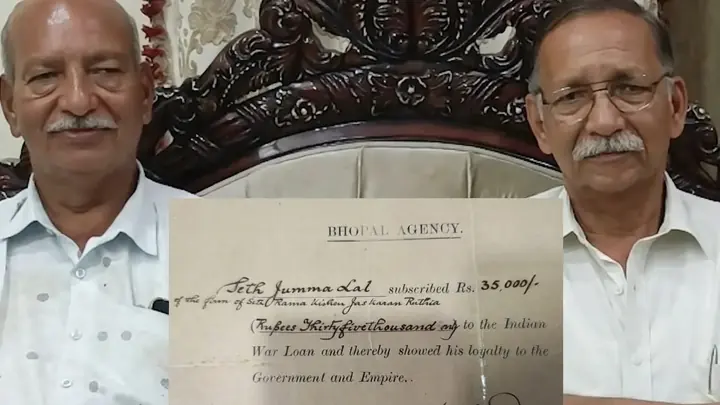
A 109-year-old claim involving an investment of 35 thousand rupees made during the First World War has brought a Madhya Pradesh business family into contact with the British government. The family of Seth Jumma Lal Ruthia says the money was invested in the Indian War Loan in 1917 and is now seeking an account of what happened to it.
The British Debt Management Office (DMO), however, has rejected the claim as an acknowledged liability. Its response was effectively: “हमारे रिकॉर्ड में कोई देनदारी नहीं!” or, in English, “Our records show no liability.”
The dispute concerns a sum deposited during the period of British rule. The Ruthia family says it has a certificate dated 4 June 1917 that records the investment of 35 thousand rupees in the Indian War Loan.
The family has linked the certificate to the Seth Ramkishan Jaskaran Ruthia firm, which was active in the then Bhopal State. The document is also said to carry the signature of W.S. Davis, who was the British political agent in Bhopal at that time.
According to the family, the certificate mentions an interest rate of 5.5 percent. The documents have remained in the family’s possession for more than a century and now form the main basis of its claim.
The matter has been raised by the family of Vivek Ruthia, a resident of Sehore in Madhya Pradesh. The family says that the original amount has never been returned. It contacted British officials through its legal adviser, Shreyansh Raniwala, and provided the old documents in support of the claim.
The response from the British office was sent by email to Raniwala on 16 October 2026. The DMO said that, even after an investigation, it had not found any evidence to establish that the loan was a financial liability of the British government.
The office did not make clear whether the amount deposited in 1917 had ever been paid back. This has left the central question unanswered: was the investment settled at some point, or does the family still have an unpaid claim?
The Ruthia family is asking British authorities to clarify whether historical records contain any reference to the investment and what happened to the money. Family-linked social worker Vinay Ruthia questioned how an earlier payment could be established without a record of its settlement.
“If the amount was already paid, where is the record of its settlement?” the family has asked. In the source material, the family’s question is stated as: “कर्ज चुकाया तो उसका रिकॉर्ड कहां है?”
The family’s position is that the certificate shows that 35 thousand rupees were deposited in the Indian War Loan during the First World War. It wants the British authorities to examine the historical documents and provide a clear account of the payment, interest and final settlement, if any.
The DMO’s reply has not accepted any outstanding amount. At the same time, the response does not establish that the money was repaid. It only says that the office has not found evidence proving that the loan is a liability of the British government.
This distinction is important in the 109-year-old dispute. The British office has not acknowledged that a sum is still due, but its reply also does not provide a clear payment record for the original investment. As a result, the question of whether the amount was ever returned remains unresolved.
The family has also tried to estimate what the original 35 thousand rupees could be worth today. It says that if 5.5 percent annual compound interest were applied to the amount for 109 years, the sum could reach several crore rupees.
The family has estimated an even higher value by taking the rise in gold prices into account. However, these are calculations made by the family. They have not been accepted by the British government as an acknowledged debt.
The actual amount, if any, would depend on the terms recorded in the original certificate, the nature of the interest mentioned in it, and whether there is evidence of any earlier payment or settlement. The document’s existence provides the basis for the family’s claim, but by itself it does not prove that the British government is legally required to pay the amount today.
The next step in the matter will therefore depend on the historical records and the conditions attached to the 1917 investment. The family wants the records to show whether the money was paid back, when it was paid, and how the account was closed.
For now, neither has the British government accepted liability for the 35 thousand rupees, nor has a clear record of repayment emerged. The family is continuing to seek an explanation based on the certificate dated 4 June 1917 and other historical documents connected with the Indian War Loan.
The case, which began with a deposit made by Seth Jumma Lal Ruthia during the First World War, now rests on two unresolved issues: what the original investment terms were, and whether the money was ever paid or formally settled.
Frequently asked questions
What is the Ruthia family’s claim about?
The family claims that 35 thousand rupees were invested in the Indian War Loan in 1917 and that the amount has never been returned.
What document supports the family’s claim?
The family cites a certificate dated 4 June 1917, linked to the Seth Ramkishan Jaskaran Ruthia firm, which records the investment and lists an interest rate of 5.5 percent.
How did the British Debt Management Office respond?
The DMO rejected the claim as an acknowledged liability, saying its investigation found no evidence that the loan was a financial liability of the British government.
Has the DMO confirmed that the money was repaid?
No. The DMO did not clarify whether the 1917 investment was repaid, leaving the settlement status unresolved.
You may also like
 Politics
Narottam Mishra Missing From Newly Approved Madhya Pradesh BJP Core Group
 Politics
Madhya Pradesh CM Mohan Yadav Leads Yoga Session in Barwani
 Politics
Madhya Pradesh Congress to Launch Online Membership Drive in December, Target 44 Lakh
 Politics
Shivraj Singh Chouhan Meets BJP Leader Biplv Kumar Dev In Bhopal
Most read
- 1
Xi Orders Urgent Rescue Efforts After Tibet Earthquake Kills 16, Injures 54
- 2
Schools Shut in Five Tamil Nadu Districts, Including Chennai, Amid Heavy Rain
- 3
Hong Kong Insurance Authority Tightens Premium Financing Oversight as Risks Emerge
- 4
Madanpur Masters Beat Firozabad Fighters by Two Runs in T-10 Opener
- 5
eMudhra Certificate: 8 weak certificates raise Internet Security concerns as browsers act
Comments
No comments yet. Be the first to comment.