
Adilabad Plans Lac Cultivation Expansion After 286 Tribal Families Earn Extra Income
Adilabad plans to expand lac cultivation to 20 villages after 286 tribal families earned additional income from forest trees.

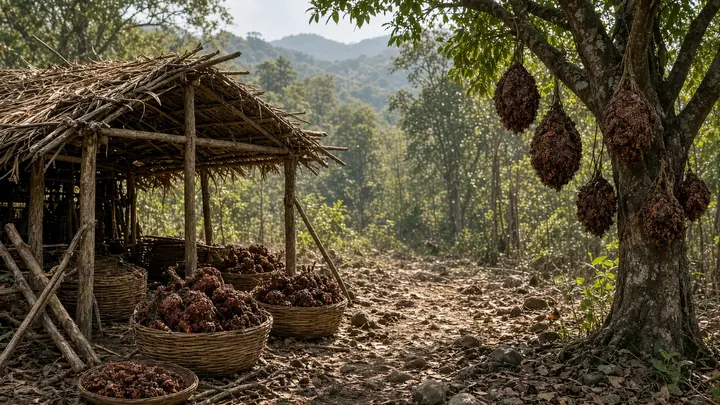
In Adilabad, tribals find new sources of income from forests
The Adilabad district administration is planning to expand lac cultivation to 20 villages after 286 tribal families earned additional income from the first phase of the programme.
The expansion will cover 370 tribal families and approximately 6,700 Palash and other suitable trees. A proposal worth ₹40 lakh has been approved under the Aspirational Blocks Programme for this expansion.
Lac cultivation adds to farm income
For generations, tribal communities in Adilabad have depended on forests for food, firewood and their livelihoods. Many families cultivate small patches of land and collect forest produce to support themselves. The new initiatives are giving some families ways to earn from trees and flowers around their villages without giving up farming or their traditional occupations.
In Narnoor mandal, about 330 km from Hyderabad, 286 families from the Kolam, Gond and Lambada communities earned between ₹3,500 and ₹8,000 each by harvesting lac. Lac is a natural resin produced by insects on certain trees.
The lac cultivation programme was introduced in 2025-26 across 12 villages in Narnoor mandal. It covered 3,760 Palash trees. The process involves introducing lac-producing insects onto suitable trees, allowing them to secrete resin that can later be collected and sold. The cultivation does not require the trees to be cut down.
“The initiative was introduced in coordination with the Forest Department. It covered 12 villages in Narnoor mandal, where 3,760 Palash trees were brought under scientific lac cultivation,” Adilabad Collector Rajarshi Shah told The Hindu.
Most participating families had no previous experience in lac cultivation, according to Mr. Shah. Master trainers were brought from Jharkhand to teach the villagers how to introduce the insects onto trees, maintain the crop and harvest the resin.
Village-level Van Sanrakshan Samitis, or forest protection committees, were also involved in the programme. According to officials, all 286 families who took part in the first phase harvested lac and earned between ₹3,500 and ₹8,000 each.
For Pendur Laxman, a tribal farmer from Sungapur village, lac cultivation has become another source of income apart from farming. He earned around ₹27,000 from one cultivation cycle and approximately ₹45,000 over the year from multiple cycles.
“We have always depended on farming for our livelihood. Lac cultivation has now given us an additional source of income without much investment,” he said.
The district administration is also working on collective marketing arrangements to help families sell their produce. These arrangements are intended to reduce cultivation costs wherever natural regeneration of lac insects is possible.
The initiative has also drawn the attention of NITI Aayog, which shared details of the programme on social media. It described lac cultivation as a low-cost activity that does not require trees to be cut down and said it could help tribal communities earn more from locally available resources.
Mahua flowers turned into laddus
In Khairdatwa village, 12 tribal women have come together to make laddus from Mahua flowers collected from the forests. The women are associated with self-help groups and are part of the Girijan Mahua Laddu Production Unit.
Mahua flowers are commonly found in the region and have been collected by tribal families for various uses for generations. The women are now processing the flowers into laddus instead of selling them only as raw produce.
The unit was established with financial assistance from government programmes. It received ₹5 lakh under the Start-up Village Entrepreneurship Programme of the Deendayal Antyodaya Yojana-National Rural Livelihoods Mission. It also received another ₹5.60 lakh under the Aspirational Blocks Programme for machinery and setting up the unit.
The Adilabad district administration is supporting both the lac cultivation programme and the Mahua laddu initiative to help tribal families earn additional income from resources available in their villages.
Mr. Shah said the Mahua initiative was intended to help tribal women earn more by processing forest produce into finished products. Instead of depending entirely on the sale of raw Mahua flowers, the women can now take part in making and selling the laddus.
Finding buyers remains important for the unit to continue operating. The Mahua laddus are also being linked to nutrition-related supplies for tribal Ashram schools and Anganwadi centres, according to the Collector.
Officials hope the initiative will provide income to the women and encourage them to manage small enterprises in their villages. The programme gives the women a role in processing and marketing a forest product that families have traditionally collected.
Income will depend on regular production and buyers
The first lac harvest has brought earnings to participating families, but regular production and access to buyers will determine how much they can earn in the coming years. The proposed expansion will take the programme beyond the 12 villages covered in its first phase and bring more tribal families and trees into the activity.
The Mahua laddu unit faces a similar requirement. The women will need regular orders if the unit is to provide a steady income. Both initiatives therefore depend not only on the availability of forest resources but also on continued production, organised marketing and access to buyers.
Source: The Hindu
Frequently asked questions
How many tribal families benefited from the first phase of lac cultivation in Adilabad?
A total of 286 tribal families earned additional income from the first phase.
How much did participating families earn from lac cultivation?
The families earned between ₹3,500 and ₹8,000 each.
Where was the first phase of the lac cultivation programme implemented?
It was implemented across 12 villages in Narnoor mandal and covered 3,760 Palash trees.
How many families will benefit from the planned expansion?
The expansion to 20 villages will cover 370 tribal families and about 6,700 Palash and other suitable trees.
You may also like
 Agriculture
Adilabad Cotton Opens at Record ₹9,260, Surpasses MSP of ₹8,667
 Madhya Pradesh
Indore Administration Uses Bulldozers, Clears 50,000 Sq Ft Near Airport
 Health
Yashoda Medicity completes one year, highlights cancer care, complex transplants and public health initiatives
 National
Bhoomi Pujan Held for Parshuram Pillar in Kareli
Most read
- 1
Xi Orders Urgent Rescue Efforts After Tibet Earthquake Kills 16, Injures 54
- 2
Schools Shut in Five Tamil Nadu Districts, Including Chennai, Amid Heavy Rain
- 3
Hong Kong Insurance Authority Tightens Premium Financing Oversight as Risks Emerge
- 4
Madanpur Masters Beat Firozabad Fighters by Two Runs in T-10 Opener
- 5
eMudhra Certificate: 8 weak certificates raise Internet Security concerns as browsers act
Comments
No comments yet. Be the first to comment.