
Just 13% of Indian Firms Have Scaled Voice AI, NASSCOM Report Finds
India’s next Voice AI challenge is no longer just about building voice agents. The bigger task is making those agents accurate, reliable and capable of handling real conversations with customers.
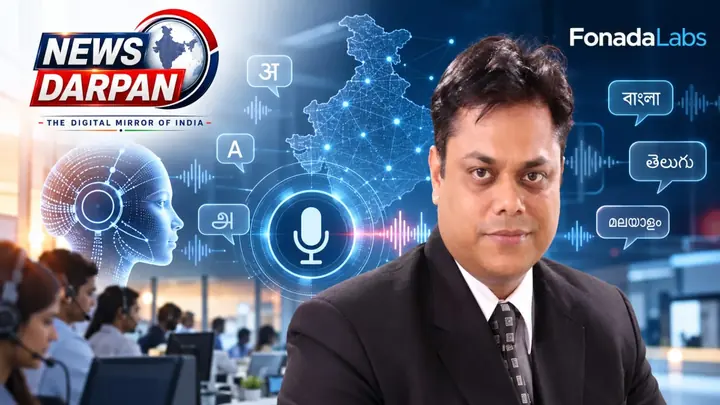
India’s next Voice AI challenge is no longer just about building voice agents. The bigger task is making those agents accurate, reliable and capable of handling real conversations with customers.
Companies in India are rapidly adopting Voice AI to improve customer service, sales and other business processes. However, moving this technology from early experiments to dependable, large-scale use remains a major challenge.
The difficulty comes from India’s linguistic diversity, regional accents, switching between Hindi and English, and the need to understand customers clearly even when there is noise around them. These factors can affect how well a Voice AI system understands a customer and responds to the actual problem.
According to figures shared with reference to NASSCOM’s India Voice AI Readiness 2026 report, only 13 percent of the organisations surveyed have implemented Voice AI at scale across multiple customer journeys. More than 30 percent of organisations reported inconsistencies in understanding and handling regional Indian accents.
These figures underline an important question about the next phase of Voice AI in India. Will the focus remain on creating more voice agents, or will companies concentrate on improving their accuracy, reliability and ability to work in real-world conditions?
Voice AI-based systems can be used for customer support, appointment booking, lead qualification, payment reminders and sales. A system that performs well in a controlled environment, however, may not necessarily be equally effective when it interacts with real customers.
During an actual call, a customer may speak quickly, use local words or mix Hindi and English in the same sentence. Network quality and surrounding noise can also affect the performance of the system. Conversations may change direction suddenly, making it harder for the system to understand what the customer needs.
In such situations, converting the customer’s voice into text is not enough. The system must understand the customer’s requirement, provide the right response and transfer the conversation to a human representative when necessary.
This makes the quality of the entire conversation important. A Voice AI system has to do more than recognise individual words. It must understand the context, respond naturally and identify when an automated answer may not be enough.
Indian languages and regional accents are central to this challenge. In a multilingual country such as India, the success of Voice AI depends on how well it can understand different languages and different ways of speaking.
Even people who speak the same language may differ in their accents, vocabulary and speaking speed. These differences can affect the way a Voice AI system interprets a conversation.
The use of mixed Hindi-English speech is another important challenge. A customer may use technical terms in English while explaining the rest of the issue in Hindi. If a system cannot handle this change accurately, the possibility of giving an incorrect response or only partially understanding the customer’s problem increases.
For Voice AI to work effectively in real-world situations, companies therefore need to focus on several capabilities. These include speech recognition, noise-reduction technology, the ability to respond in a natural voice and systems that can understand the context of a conversation.
Integration with existing business systems is also necessary for large-scale adoption. Building a voice agent alone is not enough. The agent must also be connected to a company’s existing CRM, telephony infrastructure, customer service platform and other business systems.
Clear rules are needed for situations in which a matter is complex, sensitive or remains unresolved. Under these rules, the conversation should be transferred to a human representative when required.
Such a process can reduce the need for customers to explain the same problem repeatedly. It can also help prevent incorrect or incomplete solutions from being given through automation.
Experts say the usefulness of Voice AI should not be measured only by the number of calls that have been automated. Other measures are also important. These include whether the customer’s problem was resolved, the rate of resolution during the first interaction, customer satisfaction, the quality of the conversation and the cost per contact.
FonadaLabs, the research and innovation unit of enterprise communication platform company Fonada, is working on different aspects of voice technology. According to the company’s profile, its technology platform focuses on speech recognition, or ASR, text-to-speech, or TTS, voice cloning, noise cancellation and voice intelligence.
Fonada’s platform also provides cloud telephony, contact centre, messaging and communication APIs. According to the company, the purpose of integrating these technologies is to provide businesses with automation and communication capabilities across different channels used for customer interaction.
FonadaLabs co-founder Nitish Gopalani has more than 25 years of experience across telecommunications, IT infrastructure, sales, marketing and business development. According to the company’s profile, his focus is on making enterprise-level technology more accessible and practical, while improving security, operational efficiency and customer experience.
The next phase of Voice AI will be important for solutions that can do more than answer questions. The focus will be on systems that can understand a customer’s problem and help resolve it.
To achieve that, companies will need to give equal attention to language and accent accuracy, integration with existing systems, data security and arrangements for human intervention when necessary.
At the enterprise level, the success of Voice AI will not be decided only by the number of calls it can handle. The more important test will be how well the technology understands customer needs, how reliably it delivers service and how positively it affects business costs and operational efficiency.
India’s diverse linguistic environment could therefore determine the difference between a successful Voice AI experiment and a business solution that can be used effectively at scale. The technology will have to prove that it can function accurately not only in controlled demonstrations, but also in the varied and unpredictable conversations that take place between companies and their customers.
Frequently asked questions
What percentage of Indian organisations have implemented Voice AI at scale?
According to figures shared with reference to NASSCOM’s India Voice AI Readiness 2026 report, 13 percent of surveyed organisations have implemented Voice AI at scale across multiple customer journeys.
What challenges affect Voice AI performance in India?
India’s linguistic diversity, regional accents, Hindi-English code-switching, network quality and surrounding noise can affect how well Voice AI understands and responds to customers.
What percentage of organisations reported difficulty with regional Indian accents?
More than 30 percent of organisations reported inconsistencies in understanding and handling regional Indian accents.
What should Voice AI systems do beyond converting speech into text?
They should understand the customer’s requirement, respond appropriately, maintain context and transfer the conversation to a human representative when necessary.
What business tasks can Voice AI support?
Voice AI can support customer service, appointment booking, lead qualification, payment reminders and sales.
You may also like
 National
UP Women’s Toilet Built Under Swachh Bharat Remains Locked in Village
 Madhya Pradesh
Flight Cancellations Delay Return of Nearly 4,000 Indian Umrah Travellers
 Religious
Maharishi Valmiki Jayanti Celebrated Across India on October 26
 National
Swachh Bharat Women’s Toilet Locked for Years in UP Village, Garbage Piles Up
Most read
- 1
Xi Orders Urgent Rescue Efforts After Tibet Earthquake Kills 16, Injures 54
- 2
Schools Shut in Five Tamil Nadu Districts, Including Chennai, Amid Heavy Rain
- 3
Hong Kong Insurance Authority Tightens Premium Financing Oversight as Risks Emerge
- 4
Madanpur Masters Beat Firozabad Fighters by Two Runs in T-10 Opener
- 5
eMudhra Certificate: 8 weak certificates raise Internet Security concerns as browsers act
Comments
No comments yet. Be the first to comment.