
Madhya Pradesh Commission Meets in Indore to Review Administrative Units
Administrative Unit Reorganisation Commission holds meeting in Indore Focus on public convenience and better service delivery The Madhya Pradesh Administrative Unit Reorganisation Commission held an

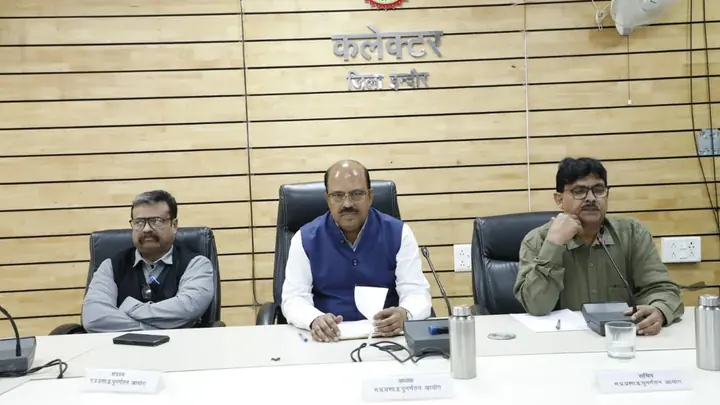
Administrative Unit Reorganisation Commission holds meeting in Indore
Focus on public convenience and better service delivery
The Madhya Pradesh Administrative Unit Reorganisation Commission held an important meeting in Indore on 18 November 2026 to discuss public convenience, good governance and administrative efficiency.
The meeting was held at the Administrative Complex. Commission Chairman S.N. Mishra, member Mukesh Shukla, Secretary Akshay Singh, District Panchayat Chief Executive Officer Himanshu Prajapati, and officers from the concerned administrative and related departments were present.
Addressing the meeting, S.N. Mishra explained the purpose, scope and procedure of the Administrative Unit Reorganisation Commission. He also outlined the key areas identified for the reorganisation of administrative units.
“The reorganisation of administrative units will be carried out keeping public convenience, public expectations and better service delivery in mind,” the Commission Chairman said.
Mishra clarified that the commission is not connected with the delimitation of Assembly and Lok Sabha constituencies. The delimitation of Assembly and Lok Sabha constituencies is carried out through a separate central commission.
The Madhya Pradesh Administrative Unit Reorganisation Commission has been constituted to review and improve the state’s administrative units and their functioning. These units include divisions, districts, subdivisions, tehsils, development blocks and janpads.
Mishra said the commission had already conducted district-level meetings in 51 districts of the state. Indore is the 52nd district where the commission is holding a meeting. In large districts, the commission is also travelling to different locations, discussing administrative arrangements with concerned officers and studying the existing system.
Commission separate from delimitation body
Mishra said confusion had arisen several times about the area of work of the Administrative Unit Reorganisation Commission. He said the delimitation of Assembly and Lok Sabha constituencies and the reorganisation of administrative units are separate processes.
The central delimitation commission deals with Assembly and Lok Sabha constituencies. The Madhya Pradesh Administrative Unit Reorganisation Commission is examining the boundaries, structure and administrative arrangements of the state’s administrative units.
The review covers divisions, districts, subdivisions, tehsils, development blocks and janpads. Mishra said commissions had also been constituted in the past for changes in administrative boundaries and administrative reforms.
He said the present commission’s work was not limited to changing boundaries or creating new administrative units. Its objective also includes administrative reforms suited to present requirements.
Boundaries to be reviewed together
Mishra said the appropriate size and structure of administrative units must be decided after considering the state’s geographical conditions, population, area, expectations of citizens and the availability of administrative facilities.
He said that during earlier changes in district boundaries, an entire block or tehsil was sometimes not included in one administrative unit. This created difficulties for citizens in reaching the district headquarters.
The commission will examine the boundaries of tehsils, blocks, subdivisions and districts in a coordinated manner. The aim is to ensure that ordinary citizens can receive administrative services more easily.
Mishra said public expectations were extremely important in a democratic system. Administrative units should be structured in a way that citizens do not have to travel unnecessary distances to access government schemes and services or to get their complaints resolved.
The administrative system, he said, should become more citizen-oriented and accessible.
Suggestions sought on four main areas
Mishra said the commission was mainly seeking suggestions and carrying out studies on four subjects.
These include necessary changes in the boundaries of existing administrative units; guiding principles and criteria for the formation of new administrative units in the future; the structure of posts in administrative units; and the efficiency and skill development of officers and employees.
He said clear criteria would be needed for the creation of new administrative units in the future. These criteria would have to take into account population, area, geographical conditions, administrative facilities and the expectations of citizens.
Mishra said a new unit should not be created only because there was a demand for it. The availability of essential infrastructure, administrative staff and resources must also be assessed before such a unit is formed.
The commission is therefore examining both the demand for administrative units and the arrangements required to make them function effectively.
Administrative staff and skills under review
Mishra said changes in boundaries alone would not be enough to bring administrative reform. The need for administrative staff, their number, qualifications and efficiency must also be examined in line with changing times, digital systems and new technology.
He clarified that the objective was not to abolish existing posts. Instead, their roles would need to be redefined and posts could be reorganised according to requirements.
Mishra said administrative work increasingly required digital technology, data analytics, legal assistance, statistics and other specialised services. These skills and areas of expertise would need to be included in the administrative system of the future.
He said this would help government work take place more effectively and within a defined timeframe. The review of the administrative workforce is therefore part of the wider exercise to improve the functioning of administrative units.
Inputs to be collected from officers and citizens
The commission is collecting suggestions from officers at different levels and from concerned stakeholders through a questionnaire.
An arrangement has been made to send the questionnaire further through the administrative system. This will allow information and proposals to be received from field officers as well as from the tehsil and development block levels.
The suggestions will be compiled through the concerned officers and sent to the commission. Mishra asked officers to give suggestions based on their administrative experience.
These suggestions may cover problems in the existing system, the required structure of posts, working methods and issues related to efficiency. Their experience will be used as an input in the commission’s review.
Mishra also said the expectations and experiences of elected representatives and citizens would be given an important place in the process. Citizens can send their suggestions to the commission through the Collector.
Balance needed between small and large units
Mishra said administrative units must be of a size that allows their work to be conducted smoothly.
If an administrative unit is too small, the availability of officers and employees and the conduct of work may be affected. If a unit is too large, administrative control, monitoring and the delivery of services to citizens can become difficult.
He said a balanced and practical arrangement would therefore be necessary between these two situations.
Mishra added that the expectations of citizens also increase when a new administrative unit is created. For this reason, the required offices, schools, health facilities, specialised services, infrastructure and adequate administrative staff must be available in the new unit.
The creation of a new administrative unit, he said, should be accompanied by the facilities needed to meet the expectations that come with it. This would ensure that citizens receive the services they expect after the new unit is formed.
Study of administrative systems in other states
Mishra said the commission was also studying administrative systems in different states.
For this purpose, the commission is visiting other states to examine their administrative structures, working methods, post arrangements and models of reorganisation. The experiences and suggestions from different states will be examined before recommendations are prepared for Madhya Pradesh.
He said the commission’s basic objective was to make the administrative system more effective, efficient, accountable and citizen-oriented.
The recommendations are intended to help ensure that the benefits of government schemes, policies and services reach ordinary citizens more easily. Mishra said citizen convenience and the quality of public service would remain the highest priorities during the reorganisation of administrative units.
During the meeting, commission member Mukesh Shukla gave information about the collection of details through the questionnaire and the prescribed form.
You may also like
 National
Shailesh K. Pathak Appointed Vice-Chairperson of MP Industrial Corridor SPV
 National
Chhath Mahaparv Concludes in Indore After Final Arghya to Rising Sun
 Accident
Late-Night Fire Breaks Out on Indore Girls’ Hostel Rooftop, Students Evacuated Safely
 National
Indore-Depalpur Duo Secures Second Place in Swachhata Survey
Most read
- 1
Bucharest Hosts Romania’s First Grand Diwali Festival, Draws 1,500 Guests
- 2
Bhopal Trophy-2026 Opens With 59 Bouts, India’s Istanbul Selection Begins
- 3
IABF Chief Rakesh Mishra to Attend Bhopal Boxing Trophy-2026
- 4
Nirmal Named Best Boxer, 12 Selected to Represent India at IBA President Cup
- 5
Gonda’s Grand Shri Ram Katha Begins November 17, Yogi to Attend
Comments
No comments yet. Be the first to comment.