
Madhavrao Scindia Chose Separate Political Path, Said He Could Decide
Madhavrao Scindia chose a political path separate from his mother, said he was now capable of taking his own decisions The political history of the Scindia royal family is marked by a sharp

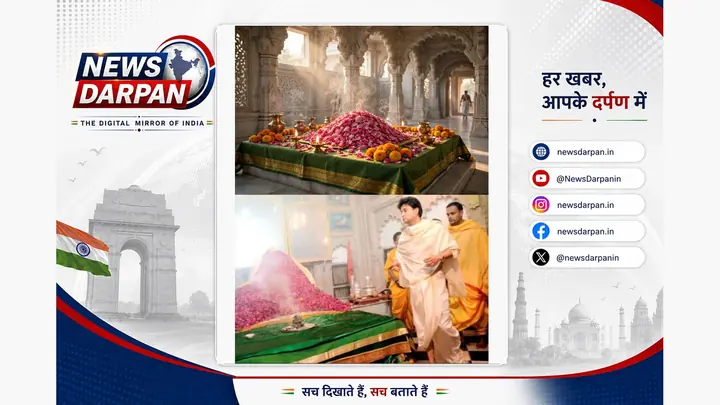
The political history of the Scindia royal family is marked by a sharp difference between the paths chosen by Rajmata Vijayaraje Scindia and her son Madhavrao Scindia. Vijayaraje Scindia began her political career with the Congress before moving to the Bharatiya Jana Sangh and later becoming one of the prominent leaders of the Bharatiya Janata Party. Madhavrao Scindia, however, chose a different route and built his political career in the Congress.
Their political ideologies were different, but both mother and son retained influence in their respective areas. Madhavrao Scindia repeatedly showed that he wanted to build his political identity through his own decisions and work, rather than depend only on his family background.
At one point, when the Congress denied him a ticket, Madhavrao Scindia broke away from the party and formed his own political organisation. He contested the election on the strength of his political support and reached the Lok Sabha for the seventh time.
The history of the Scindia family also includes several accounts of social harmony and religious coexistence. Mahadji Scindia gave a Muslim water carrier named Rane Khan the status of a brother and made him a jagirdar. Mahadji Scindia also regarded Baba Mansoor Shah as his guru. Another account says that Madhav Maharaj joined a Muharram procession after a tazia was destroyed in a fire.
When Madhavrao Scindia formed his own party
The biggest political turning point in Madhavrao Scindia’s career came in 1996. At the time, the Congress government at the Centre was led by P.V. Narasimha Rao, and Madhavrao Scindia was the Human Resource Development Minister.
His name appeared in the Jain Hawala diaries, after which he resigned from the ministerial post. Allegations were made that he had illegally received about 75 lakh rupees. The allegations, however, were not proved.
When preparations began for the 1996 Lok Sabha election, the Congress refused to give Madhavrao Scindia a ticket. The decision was a major political and personal setback for him.
Madhavrao Scindia had first entered the Lok Sabha in 1971 and had continued to win elections after that. Even the Janata Party wave that swept across the country in 1977 could not defeat him.
Angered by the Congress decision, Madhavrao Scindia decided to leave the party. He formed a new political party called the Madhya Pradesh Vikas Congress, or MPVC.
He contested the election using his own political strength and succeeded in reaching the Lok Sabha for the seventh time. The result showed that his electoral base remained intact even after he had separated from the Congress.
The political distance did not last for long. In 1998, after Sitaram Kesri was removed from the post of Congress president and the equations within the party changed, Madhavrao Scindia returned to the Congress.
He remained with the Congress until the end of his life. Madhavrao Scindia died in a plane crash in Mainpuri, Uttar Pradesh, on 30 September 2001. He was travelling to attend a Congress programme at the time. His death left the Congress without one of its influential leaders.
Vijayaraje gave up Guna seat for her 26-year-old son
The Scindia family’s political journey began in 1957. Before that, the family had no particular connection with active politics. The merger of princely states after Independence and the changing political situation encouraged the royal family to enter electoral politics.
The State of Madhya Bharat was formed on 28 May 1948. Maharaja Jivajirao Scindia was made its Rajpramukh.
The family’s political and ideological connections were influenced by the Hindu Mahasabha. Jivajirao Scindia also disagreed with the policies of the Congress.
Political circumstances later changed, and Rajmata Vijayaraje Scindia entered active politics. In 1957, she contested the Guna Lok Sabha seat on a Congress ticket and won. She again reached the Lok Sabha on a Congress ticket in 1962.
In 1967, Vijayaraje Scindia contested two elections. She fought from the Karera Assembly seat on a Bharatiya Jana Sangh ticket and from the Guna Lok Sabha seat on an Independent Party ticket. She won from both constituencies.
After the victories, she gave up her Lok Sabha membership and took charge as the Leader of the Opposition in the Madhya Pradesh Assembly.
It was during this phase that her son Madhavrao Scindia entered politics. In 1971, Vijayaraje Scindia vacated the Guna Lok Sabha seat so that her son could contest from it.
Madhavrao Scindia was only 26 years old at the time. He contested as an Independent candidate with the support of the Bharatiya Jana Sangh and won the election. This was his first entry into the Lok Sabha.
His political journey therefore began within the political space associated with his family, but his later decisions took him away from his mother’s ideological path. The difference became sharper after the Emergency.
The Emergency changed the political paths of mother and son
When the Emergency was imposed in the country in 1975, Vijayaraje Scindia was arrested. Madhavrao Scindia, on the other hand, went to Nepal.
He later returned to India after receiving an assurance from the government that he would not be arrested.
Vijayaraje Scindia’s autobiography, “Rajpath Se Lokpath Par”, refers to this period. According to her account, Madhavrao Scindia decided to join the Congress partly because he feared that his mother could be sent to jail again if he did not do so.
The political choices of the two therefore moved in different directions. Vijayaraje Scindia remained associated with the Jana Sangh, while Madhavrao Scindia moved closer to the Congress.
The Emergency ended, and Lok Sabha elections were held in 1977. By then, Madhavrao Scindia had separated from the Jana Sangh and moved closer to the Congress.
He contested the election from Guna as an Independent candidate. The Congress did not field a candidate against him and supported him.
Despite the Janata Party wave across the country, Madhavrao Scindia won the election. Another notable part of the contest was that his mother, Vijayaraje Scindia, appealed to people to vote for her son despite their political differences.
The events of this period completed the separation between the political paths of mother and son. Vijayaraje Scindia stayed with the Jana Sangh. When the Bharatiya Janata Party was formed in 1980, she became one of its founding leaders.
Madhavrao Scindia, meanwhile, established his place in the Congress. The same family thus produced two prominent political figures who represented two different political ideologies.
“I am now capable of taking my own decisions”
An account recorded by Vijayaraje Scindia in her autobiography describes a significant conversation about Madhavrao Scindia’s political direction.
After the Emergency, Madhavrao Scindia made it clear that he was now capable of taking his own decisions. The statement reflected more than a disagreement between a mother and her son over party politics.
It represented a young leader’s decision to create an independent political identity. Madhavrao Scindia did not want his political direction to be determined entirely by his family’s earlier choices.
The result was that the mother and son became representatives of two separate political traditions within the same family. Vijayaraje Scindia remained active in BJP politics, while Madhavrao Scindia became one of the important faces of the Congress.
Both continued to retain political influence in their respective spheres. Their differences did not erase the fact that both had major public roles, but they followed separate routes to maintain those roles.
Madhavrao Scindia’s later decision to form the Madhya Pradesh Vikas Congress in 1996 also fitted into this pattern. When the Congress denied him a ticket, he did not withdraw from electoral politics. He created his own party, contested the election and won. He later returned to the Congress in 1998.
How Vijayaraje entered politics after meeting Nehru
The Scindia family’s entry into politics was also shaped by the power structure and political conditions of the period after Independence.
The Congress had a broad influence across the country. Jivajirao Scindia’s ideology, however, did not match the Congress. He leaned towards the Hindu Mahasabha, and the organisation received his patronage in the Gwalior-Guna region.
Vijayaraje Scindia wrote in her autobiography that her husband did not consider the Congress a party that worked for the interests of ordinary people. At the same time, there was concern that opposition to the Congress could create problems for the royal family.
Because of this concern, Vijayaraje Scindia sought a meeting with Prime Minister Jawaharlal Nehru and Indira Gandhi in 1956 while she was in Mumbai. The meeting took place at Three Murti Bhavan in Delhi.
During the meeting, she assured them that Jivajirao Scindia would neither provide financial help to the Hindu Mahasabha nor undertake any political activity against the Congress.
Nehru was not completely satisfied with the assurance. He told her that not opposing the Congress and being with the Congress were two different things.
Vijayaraje Scindia was then advised to meet the then Home Minister Govind Ballabh Pant and Rail Minister Lal Bahadur Shastri.
During the meeting, Jivajirao Scindia was advised to contest an election on a Congress ticket. When he said that he was not interested in politics, Vijayaraje Scindia was asked to contest the election herself.
She initially refused. After returning to Gwalior, however, she considered the political circumstances and changed her mind.
She eventually joined the Congress and won the 1957 Lok Sabha election from Guna. With that victory, she entered Parliament and the Scindia family’s active political journey began.
From the Congress to the Jana Sangh and BJP
Vijayaraje Scindia won the 1957 and 1962 Lok Sabha elections on Congress tickets. Political conditions began to change during the 1960s.
Jivajirao Scindia died in 1961. A few years later, Jawaharlal Nehru also died in 1964. New political equations began to develop both in national politics and in Madhya Pradesh.
Vijayaraje Scindia did not have good relations with Dwarka Prasad Mishra, who was the Chief Minister of Madhya Pradesh at the time. As political differences deepened, she joined the Bharatiya Jana Sangh in 1966.
She did not return to the Congress. Instead, she continued to advance the politics of the Jana Sangh.
When the Bharatiya Janata Party was formed in 1980, Vijayaraje Scindia became one of its founding members. She spent a major part of her political life with the BJP and became one of its strong leaders.
The change in her political affiliation created a clear contrast within the family. The mother became an important leader of the BJP, while her son took a significant role in the national politics of the Congress.
Madhavrao Scindia’s political identity was therefore not simply a continuation of his mother’s. His first Lok Sabha election had been fought as an Independent candidate with Jana Sangh support, but he later moved towards the Congress and remained there for most of his political career.
Mahadji Scindia and Rane Khan
The history of the Scindia dynasty is connected not only with political events but also with social and cultural relationships. Several accounts in the history of the family refer to Hindu-Muslim unity and mutual trust.
The beginning of the Scindia dynasty is associated with Ranoji Rao, who is said to have belonged to Kanherkheda village near Satara in Maharashtra.
Mahadji Scindia is regarded as one of the most influential rulers of the dynasty. He took part in the Third Battle of Panipat in 1761 and was seriously injured in the battle.
Historical accounts say that a water carrier named Rane Khan saved his life.
Mahadji Scindia did not forget this help. After establishing control over Gwalior in 1765, he made Rane Khan a jagirdar.
He went further than giving him the position of an associate or jagirdar. Mahadji Scindia declared Rane Khan his brother.
The episode is regarded as an important example of the old relationship between the Scindia royal family and the Muslim community.
Mahadji Scindia strengthened Maratha power through his military and political skills and expanded his influence. Under his leadership, the strength of the Scindia state grew considerably.
The account of Rane Khan is therefore placed within a larger history of the dynasty, in which political authority and personal bonds existed alongside one another.
Mahadji Scindia adopted Daulatrao to continue the dynasty
A detail from Mahadji Scindia’s personal life is also recorded in history. He had nine wives, but he had no son. He had three daughters.
To continue the family line, he adopted his nephew Daulatrao Scindia.
Daulatrao later carried forward the legacy of the Scindia dynasty. Through the adoption, Mahadji Scindia made an arrangement for the next generation of the family as well as for the continuation of the dynasty.
The account is part of the family’s wider history, which includes the expansion of the state under Mahadji Scindia and the succession that followed through Daulatrao Scindia.
Baba Mansoor Shah was Mahadji Scindia’s guru
Another important part of the relationship between the Scindia family and Muslim society is linked to Baba Mansoor Shah.
Mahadji Scindia regarded Baba Mansoor Shah as his guru.
An urs of Baba Mansoor Shah is still organised in Gwalior. The Scindia family has traditionally taken part in the event.
This account shows that the religious and social relationships of the royal family were not restricted to one community. Along with its links to power and administration, the family also remained connected with the Sufi tradition and local religious places.
The reference to Baba Mansoor Shah is another example used to describe the social and religious environment associated with the Scindia family.
“The tazia did not burn, I burned”
A moving account of the Scindia family’s Ganga-Jamuni culture is associated with Madhav Maharaj. The incident is said to have taken place in 1925.
The account appears in the book “Madhavrao Scindia: A Life” by Veer Sanghvi and Namita Bhandare.
According to the story, preparations were under way for Muharram. A tazia had been placed in an imambara, and preparations for the procession had been completed.
A fire suddenly broke out in the imambara. The tazia was caught in the fire and was destroyed.
The incident created confusion around the Muharram event. The procession was delayed by about two hours.
When Madhav Maharaj was informed about the incident, he was deeply distressed. In an emotional statement, he said: “ताजिया नहीं जला, मैं जल गया हूं।”
Madhav Maharaj then left the palace and reached the streets, where he joined the Muharram procession. He is said to have remained with the procession throughout the day.
The account presents the incident as an example of the ruler’s sensitivity towards the religious event. It also offers a picture of a social setting in which festivals and traditions of different communities formed part of shared cultural life.
A family shaped by different ideologies
The political journey of the Scindia family contains several changes and contrasts.
Jivajirao Scindia leaned towards the Hindu Mahasabha. Vijayaraje Scindia began her political career with the Congress and later became a prominent leader of the Jana Sangh and BJP.
Madhavrao Scindia took a different path from his mother and established his identity in the Congress. In 1996, he separated from the party after being denied a ticket, formed his own political party and later returned to the Congress.
The accounts associated with Mahadji Scindia and Madhav Maharaj add another dimension to the family’s history. They refer to social relationships, religious connections and traditions of harmony alongside political power.
The story of the Scindia family, therefore, extends beyond royalty and electoral politics. It includes ideological shifts, personal decisions, succession within the dynasty and relationships across communities.
From Gwalior to national politics, the family’s history has been shaped by changing political circumstances and by the choices made by individual members. Vijayaraje Scindia and Madhavrao Scindia followed different political roads, while the older accounts connected with Mahadji Scindia and Madhav Maharaj remain part of the family’s larger social and cultural legacy.
You may also like
 Politics
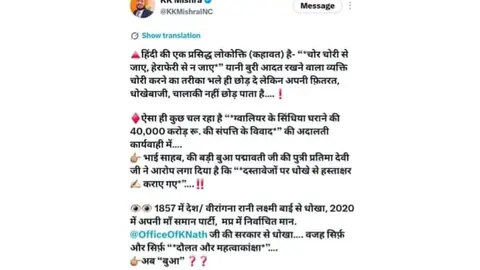
KK Mishra Takes Satirical Swipe Over Rs 40,000 Crore Scindia Property Dispute
 Politics
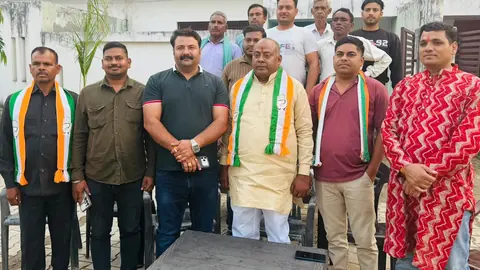
BJP Leader Hemant Sengar Returns To Congress With Dozens Of Supporters
 Politics
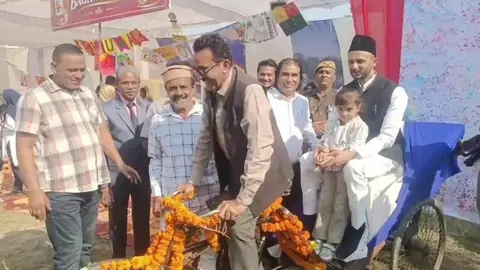
Congress Leader Seen Pulling Samajwadi Party MP's Rickshaw at Sambhal Event
 Politics
Rahul Gandhi Hoarding Sparks Political Buzz in Amethi Ahead of 2027 Polls
Most read
- 1
Saba Haider wins Illinois House election for District 84 with 70.9% vote
- 2
Phulwari Public School Celebrates Diwali With Diyas, Rangoli and Student Art
- 3
Amit Shah To Be Chief Guest At Uttarakhand Foundation Day Event
- 4
Woman Gives Birth to Baby Girl Inside 108 Ambulance in Morena
- 5
Former Agriculture MoS Lakhan Singh Rajput Leaves Dibiyapur For Kanpur With Convoy
Comments
No comments yet. Be the first to comment.